OUR STORY
Our story begins in 1942 when Hugh Willis became a tenant farmer with just a few cows and pigs. Very soon Hugh acquired an old army barracks, converted it to pig sheds and the first stage of the expansion of this family firm had begun!
The business remained a predominantly livestock-orientated operation until 1966, when Hugh’s son, John, started to
sub-contract the services of the self-built tanker he used on the farmland to spread slurry. In 1965, a new fertiliser plant had opened in Cheshire, just down the road from the farm. John’s first contracting job was to spray water to clean the approach road to the plant. The company continued working with the CF Fertiliser plant in one guise or another until the plant ceased production in 2022.
THE BIRTH OF RECYCLING
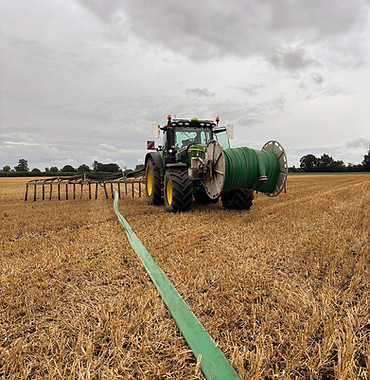
Back in 1966, one thing led to another and soon John was using his tractor and self-built tanker to empty local septic tanks and was then recycling this as natural organic fertiliser on his fields and those of neighbouring farmers keen to take advantage of this new service. He soon realised he needed more than one tractor - and so started a 50 plus year association with local Nantwich firm, Agricultural Machinery (Nantwich) Ltd (now part of the Cornthwaite Group), as they supplied the embryonic business with its first new machinery. They have been supplying the business with new machinery – from tractors to cultivators and foragers – ever since!
Gradually the business grew, and John built more tankers, bought more tractors, and employed more local people whilst all the time providing a valuable service to the Cheshire community through a combination of septic tank services, slurry removal and ‘natural organic fertiliser’ spreading.

AGRICULTURAL SUB-CONTRACTING SERVICES EXTENDED
But it wasn’t just the waste services that were in demand. John saw the opportunity to contract his services – or perhaps more importantly the services of his farm machinery – to other farmers in the area and so relieve them of the need to invest in expensive equipment of their own! Ploughing was the initial service offered, but this soon expanded into cultivation work and ultimately into harvesting, baling and silaging.
The Agricultural Contracting and Waste Disposal sides of the business continued to grow side by side through word of mouth and recommendation through the late sixties until, in the early 1970s, John decided to build two clay-lined lagoons so he could store pig and cow slurry. This storage capability led to the business being asked to take in waste collected by third parties!
In the early 1980s, aged just 15, John’s son started in the business as a tractor driver doing subcontract agricultural work and he soon got to grips with the way the business was run. His own vision as to how the business could develop began to take shape. By his early twenties, he'd become a pioneer of round baling, expanded the cultivation side of the business and critically, with his father John, acquired more land that could be used to expand the farming side of the business and upon which the ever-increasing quantities of natural fertiliser could be spread!

EVER INCREASING CIRCLES!
Thus, in 1982, the business expanded its beef production capabilities and built self-contained pig units to allow around 2,500 pigs the benefit of a purpose-built environment with outside access and indoor shelter.
By the end of the 1980s, the farm had grown considerably. The agricultural contracting side of the business had expanded and the waste collection and distribution side had grown exponentially. This was to the point where other waste collection companies were asking to use the company’s facilities to process waste on a regular basis.
GROWTH AND EVOLUTION
1996 was a pivotal year for the business. Hugh Willis retired and the Environment Agency was born!
During the 90s, the business continued to acquire land as more and more small tenant farmers found it uneconomical to continue. The self-sustaining business model developed by John meant that the company could overcome the challenges faced by small individual operators.
The business now had a mixture of arable and pastureland that allowed them to be self-sufficient – growing enough wheat, barley and grass to feed the livestock and even hold stocks in reserve; collecting, processing and spreading the slurry from the livestock onto the land to fertilise it for the next season. And all the time the waste collection, processing and distribution side of the business continued to grow organically by word of mouth.
Back in 1982, the business had bought a forager (for silage). Subcontracting with this machine had been an extremely successful venture for many years. By the late 1990s the forager was due to be replaced; but J H Willis & Son took what in hindsight was the visionary decision to prioritise the growth of the waste side of the business instead.
J H Willis & Son concentrated their efforts on building more tankers, acquiring more tractors, and taking on more drivers to satisfy the growing demands of the waste disposal business, all the time ensuring that they were working in accordance with the requirements of the new Environment Agency.
SELF-SUFFICIENT FARMING ACHIEVED
From 1942 - through three generations - Hugh, John and then David had been striving to achieve farming utopia – becoming self-sufficient by virtue of growing their own feed, harvesting and storing it, feeding it to their livestock, recycling the slurry the livestock produced and utilising this natural fertiliser to spread on the fields to provide pasture and arable land to feed the stock and start the cycle all over again.
By the turn of the 21st century, the farming side of the business was totally self-sufficient and J H Willis & Son was providing employment for a considerable number of local people, supporting the local community, and recycling more waste than any other independent family-owned business in the UK. Over 40 waste collection companies now dispose of the waste they collect through J H Willis & Son’s facilities.
THE COMING OF THE ARTICULATED VACUUM TANKERS
An articulated vacuum tanker is purpose designed to collect and transport large quantities of liquid waste. The addition of these vehicles to the fleet of tractors and self-built tanks began at the turn of the 21st century and has allowed the business to significantly extend its sphere of operations and increase its customer base (although the first two vehicles were actually bought to increase the capacity for moving waste locally between the business’s own sites and United Utilities!).
The articulated tanker fleet now operates nationwide to remove liquid waste from such diverse sites as music festivals, fishing lakes, breweries, docks, utility providers and factories. Waste is then brought back to be processed for recycling using a state-of-the-art AD plant (anaerobic digestion) - a system that was pioneered by the business over 10 years ago.
The fleet of tankers continues to grow as the reputation of the business spreads and more and more companies turn to the services of J H Willis & Son for sustainable liquid waste disposal solutions.
WORKING IN PARTNERSHIP – NOT IN COMPETITION
Throughout the long history of the business, one of the main reasons for its success has been the ability to work in harmony and partnership with other businesses rather than in competition with them.
For example, third party waste collection companies bring the waste they collect to J H Willis & Son because they know that there will not be any conflict of interest and there will be no underhanded attempts to ‘steal’ a customer. On the contrary, J H Willis & Son will always look to help other companies by working alongside them so they can fulfil their customer commitments.
J H Willis & Son also have a long history of working in conjunction with commercial cleaning and jetting organisations such as Metro Rod, Sapphire and All Drains as well as with companies like United Utilities, Veolia and Ambipar (formerly Enviroclear). Indeed, the business has a long list of satisfied blue-chip clients!
ENTER THE NEXT GENERATION
In 2018, the business welcomed the 4th generation of the family. Foraging has since been added to the list of services and the business has continued to grow.
There are a few more years to go before the 5th generation will be ready!
The future is unfolding, and the message is very clear. If you need to dispose of liquid waste, either as a third-party collector or as an actual producer of waste, then you should call J H Willis & Son and ensure that your waste is disposed of ethically, resourcefully, legally, and sustainably.


GET A QUOTE FOR ANY ONE OF OUR AGRICULTURAL OR WASTE MANAGEMENT SERVICES
CALL 0151 356 0351